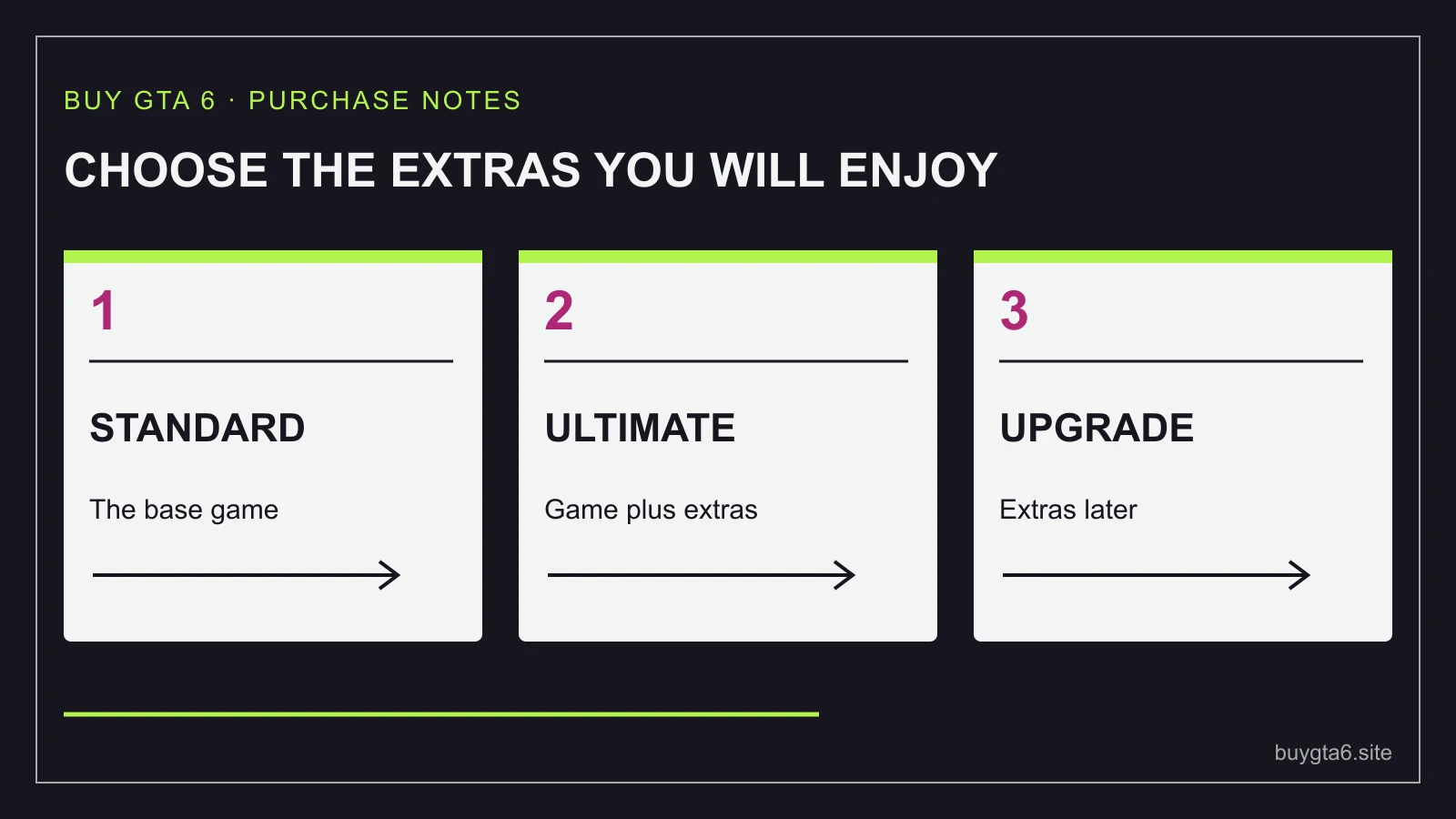
Choose GTA 6 Standard if your main aim is to play the game and keep the cost down. Choose Ultimate if its named extras are things you want, and the extra charge fits comfortably into your budget. You do not have to buy the larger edition to prove you are a big fan.
The useful question is not which edition has the longest list. It is what the extra money buys for you. Someone who loves collecting vehicles and changing a character's look may see value where someone who mainly follows the story sees little. Both can make a sensible purchase.
Rockstar's edition guide, checked on 14 October 2026, says Standard includes the game. Ultimate adds extra content, and a separate upgrade is available. Its bonuses appear through story progress rather than arriving as one pile of items at the beginning. That gives you room to choose based on your interests instead of treating Standard as an unfinished purchase.
What you are comparing
Put three things in separate boxes in your mind: the game, edition extras, and a purchase bonus. The game is the reason you are buying. Edition extras explain the difference between Standard and Ultimate. A purchase bonus may depend on when and how you order. Mixing those three can make a larger edition look better than it really is for your needs.
For example, if both listings show the same qualifying purchase bonus, do not count it as a reason to pay for Ultimate. It is present on both sides of that particular comparison. Equally, a seller's delivery service belongs in your buying decision, but it is not extra game content.
You can make a short note headed 'Only Ultimate adds this'. Write down the things that are genuinely absent from the Standard offer you are comparing. Then mark the ones you would seek out during play. Leave everything else unmarked. This turns a large marketing list into a much smaller personal decision.
| Your main aim | Starting choice | What might change it |
|---|---|---|
| Play the game for the lowest suitable total | Standard | A real offer makes the extra content affordable and appealing |
| Collect and explore the listed extras | Compare Ultimate | The price gap is bigger than your enjoyment budget |
| You do not know yet | Standard, with the upgrade option in mind | You decide the extras matter before checkout |
| Buy for someone else | Ask about their preferences | They already own the base game |
A table can guide you, but it cannot tell you what you enjoy. Take a moment to picture a normal evening playing. Would you actively use the extras, or would you forget about them once the game begins? That answer is more useful than the word Ultimate on the cover.
Think about the extras as activities, not a trophy list
The official PlayStation listing describes extras around vehicles, weapons, personal style and special destinations. Some appeal is visual. Some gives you more things to look for or places to use during your time in the game. That is a better way to think about them than treating every line as equally valuable.
Ask which part sounds fun to you. A player who changes outfits rarely may not get much joy from more styling choices. Someone who likes building a collection may care about things a story-focused player would pass over. You can enjoy a game deeply without wanting every item connected to it.
Do not turn an extra into a promise of a particular play time. A longer list does not tell us how many extra hours you personally will spend. It also does not establish how enjoyable those hours will be. Before buying, distinguish a described feature from a tested result.
The timing of access matters too. If you want immediate access to one particular item, check its unlock conditions on the current listing. Buying an edition and reaching an item are different events. Knowing that in advance avoids the feeling that your purchase is missing something simply because you have not reached the relevant point.
A useful test is to explain your choice in one sentence without using the edition name: 'I am paying extra because I like collecting and using these particular things.' If all you can say is 'I want the best one', spend a little longer looking at what the higher price actually adds.
Compare the real price gap, not two advertising headlines
On 14 October 2026, the US Xbox listing showed Standard at US$79.99+, Ultimate at US$99.99+, and the separate Ultimate upgrade at US$20.00. The displayed gap between the two full editions was US$20.00. This is a dated US store snapshot, not a promise of your final checkout total or a worldwide price.
For your decision, open both suitable offers in the same market. Check the currency, platform, edition, tax treatment and delivery charge. Compare the amount you would actually pay. A code-in-box order with shipping and a digital order without shipping need that adjustment before the difference means anything.
The simple sum is: final Ultimate total minus final Standard total equals the extra cost of choosing Ultimate now. If Standard costs less through a retailer, the gap may be different from the platform store's headline gap. If the retailer adds delivery, some of that saving may disappear.
Store credit deserves care. If you already have credit, it may reduce the new cash you need today. But it still has value because you could spend it on something else. Do not pretend an edition is free just because the payment comes out of a wallet balance rather than your bank account.
For a purely made-up example, suppose two suitable final totals are 90 and 112 in the same currency. The extra cost is 22. Ask whether you would happily spend 22 on the listed extras as a separate purchase. If the answer is no, attaching them to a full game does not make them better value.
You can also set your own limit before looking at a sale banner. Write 'I will pay up to this much more for those extras'. It is easier to judge an offer against a limit you chose calmly than to invent a limit after seeing a countdown.
The upgrade option changes the pressure to decide
Having a later upgrade route means you can separate two decisions: whether you want GTA 6, and whether you want the Ultimate extras. If you already know you want the game but are unsure about the additions, you do not need to solve both questions in one shopping session.
Waiting on the extras gives you time to see how you actually play. Perhaps you spend your evenings moving through the story and never feel a need for more items. Perhaps collecting becomes your favourite part, and the additions become much easier to judge. Either outcome is useful information.
That flexibility does not promise a future discount. A separate upgrade may cost the same, more or less when you later look. The current price and terms are what you can verify now. Do not justify Standard by assuming a sale, or justify Ultimate by assuming an upgrade price rise.
There is a practical difference between buying the upgrade and buying the complete Ultimate edition after you already own Standard. One is an addition to your purchase. The other includes the base game again. Look closely at the product title before paying. Our Standard-to-Ultimate upgrade guide explains the purchase sequence and the checks that keep those routes apart.
If you are buying a physical Standard copy, account and code steps also matter. The box is not a way to avoid the digital purchase process. Read the box, disc and download-code guide before treating it like an ordinary disc purchase.
Three buyers can reach three sensible answers
Imagine Morgan has a compatible console, a busy month, and enough spare money for Standard without touching household bills. Morgan wants to follow the story and is not interested in collecting extras. Standard is the straightforward choice. The remaining money can stay available for other needs. There is no need to turn a manageable treat into an expensive one.
Now imagine Sam sets aside money for games throughout the year. Sam enjoys vehicle collections and spends time trying different looks. The listed additions are appealing, and the final gap is below Sam's limit. Ultimate can be a good personal choice even if someone else would call those extras unnecessary. A purchase does not need to be the cheapest possible to be sensible.
Then imagine Alex is buying a birthday present and knows only that the recipient likes GTA. Alex has no clear idea which platform account they use or whether they have ordered already. Comparing edition prices is premature. The useful next step is checking ownership and preference. Our GTA 6 gift guide helps with that conversation.
These are invented examples, not reports about buyers. They show why the same edition can be right for one person and wasteful for another. Your budget, interests and existing purchases matter more than the biggest label.
Before paying, check the item rather than the label
Read the full product name on the final payment screen. Confirm that it is GTA VI for your console, in the edition you decided on. Check whether you are buying a complete game or an add-on. A product card can be clear while a search result or small thumbnail is confusing.
Look for unexpected bundles. A larger package might contain merchandise, a subscription or other items you do not want. Their presence does not automatically make it a bad offer, but compare them honestly. If you would never buy the added item on its own, do not assign it its full advertised value in your personal calculation.
For a retailer purchase, ask who handles an incorrect or missing code and what proof you receive. Keep the listing and order record. They show the edition you meant to buy if the delivered item differs. Use our offer-check guide if the seller's wording is vague.
If the checkout total is uncomfortable, step away. You do not have to prove your enthusiasm through spending. Buying an edition you can enjoy without worrying about the payment is part of making the game enjoyable.
Questions that often make the choice harder
Does a higher edition name mean I need it?
No. A name is a label, not a description of your needs. Judge the specific additions and their extra cost. If you want only the game, do not buy more simply because the larger edition sounds like the proper one.
Should I compare a retailer's Standard offer with Ultimate in a platform store?
Yes, provided both offers suit your account and console, and you compare their final totals. Include delivery or collection costs that you would actually incur. Saving on the base game can change what the upgrade route costs you overall.
What if I change my mind after buying?
Check the seller's current cancellation or refund rules before taking further action. Do not buy a second edition expecting the first purchase to be refunded automatically. The cancellation and refund guide is the useful next read.
What if the gap is tiny?
A small gap can make Ultimate attractive, but it does not repair a wrong platform, unsuitable account region or unclear seller. Get the purchase right first. Once both offers are suitable, choose the one whose extra cost feels fair for the enjoyment you expect.
The choice is finished when you can name the edition, explain why its price fits your budget, and describe what you are paying extra for. That is a much stronger answer than buying the biggest box and hoping its name does the thinking for you.
Sources and references
- Rockstar: GTA VI platforms, editions and versions ↗
- PlayStation Store: GTA VI edition descriptions ↗
- Xbox Store US: GTA VI edition and upgrade prices ↗
Sources checked 14 October 2026. Follow your exact order for current collection instructions.